

Straight Teeth Without the Metal — Invisalign Clear Aligners in Wasilla, AK
You have probably thought about straightening your teeth for years and kept putting it off. Metal brackets feel like a teenager's problem, not something you want at work. Clear aligners changed that calculation for a lot of adults. They are removable, hard to notice, and they fit around a working life. They are also not right for every case, and this page is honest about where that line falls.
What Clear Aligners Can and Cannot Fix
Most pages about aligners sell the result and skip the limits. Knowing which category your case falls into is the difference between a good outcome and a wasted year. Sun Mountain Dental Care sorts cases into these groups at the consultation, before any money changes hands.
Crowding and Spacing
Mild to moderate crowding is where aligners perform best. The same is true of gaps, which usually close predictably when the teeth on either side are healthy. The American Association of Orthodontists lists crowded teeth, gapped teeth, and crooked teeth among the conditions aligners commonly treat. These are the cases we take on most often.
Learn more about American Association Of OrthodontistsBite Problems, Within Limits
Overbites, underbites, crossbites, and open bites can respond to aligners. How well depends on how much the bite is off and whether the correction needs jaw movement. A mild overbite is a very different project from a severe one. We measure before promising anything.
Cases That Do Better With Braces
Severe rotations, teeth that need moving vertically, and large bite corrections are handled more predictably with fixed braces. Aligners can struggle to grip and control those movements. If your case sits in that group, we will tell you and point you toward an orthodontist. Starting aligners on a case that needs braces wastes your money and your time.
Teens and Adults
Adults make up a large share of aligner patients, and treatment works at any age once the teeth are fully in. Teens can do well when they are genuinely willing to wear them. Compliance is the deciding factor, not age.
How Aligner Treatment Actually Runs
Aligner treatment is a long project made of short appointments. Knowing the sequence up front makes the months ahead much less frustrating.
A Health Check Comes First
Active decay and gum disease have to be treated before any teeth get moved. That usually means a dental cleaning and exam and finishing any outstanding work. Aligners are made to the exact shape of your teeth, so restorations done afterward can spoil the fit.
Learn more about Dental Cleaning And ExamThe Digital Scan
We scan your teeth to build a three-dimensional model of your bite. The scan takes minutes and replaces the trays of putty people remember. From that model we map out how each tooth needs to move.
Waiting on Your Aligners
Your trays are manufactured off-site, not in the office. That production and shipping step commonly takes several weeks. We use that gap to confirm the plan and answer questions before anything is committed.
Attachments and the First Fit
Most cases need small tooth-coloured bumps bonded to certain teeth. These attachments give the aligners something to push against on difficult movements. Fitting them and teaching you the routine takes the better part of an hour.
Check-Ins and Refinements
You change trays on a set schedule and come in periodically so we can confirm the teeth are tracking. Most plans finish with a short round of refinement aligners to correct whatever did not move exactly as predicted. That round is normal, not a sign something failed.
Before You Start, Know What Treatment Asks of You
Aligners only move teeth while they are in your mouth. This is the part worth understanding before you pay for anything, because the work is largely yours.
The Twenty-Two Hour Standard
Aligners are worn at least 22 hours a day, taken out only to eat, drink, and clean your teeth. That guidance comes from the American Association of Orthodontists. It leaves roughly two hours of freedom across the whole day.
Learn more about American Association Of OrthodontistsMeals Are the Pressure Point
A common guideline keeps each removal to about thirty minutes so the daily total holds. Long meals, grazing through an evening, and a coffee you nurse for an hour are what quietly break a plan. Most people who fall behind do so at the dinner table.
What Slipping Actually Costs
Teeth that do not track force extra refinement trays and a longer timeline. It rarely ruins a case, but it does stretch it. Honest self-assessment now saves months later.
Retainers Come After, For Good
Teeth drift back toward where they started once pressure stops. Retainers stabilise the result, which the ADA describes as preserving what treatment achieved. Budget for them as part of the plan, not as a surprise at the end.
Learn more about ADA
How We Approach Aligner Cases
A general dental practice should be candid about which orthodontic cases it takes on. These are the commitments that shape how Sun Mountain Dental Care answers that question.
We Turn Down Cases That Need Braces
Not every case belongs in aligners, and we would rather say so at the consultation. Sending a complex case to an orthodontist costs us the work and gets you the better result.
Restorative Work Gets Sequenced Properly
Fillings, crowns, and gum treatment are handled before scanning, not squeezed in later. Because trays are built to your current tooth shapes, doing this in the wrong order means remaking them.
Appointments Built Around Valley Distances
We know many patients are driving in from well outside Wasilla. Check-ins get spaced and combined where the treatment allows, rather than scheduled for our convenience.
One Quote That Includes the Retainers
The estimate covers scanning, trays, attachments, refinements, and your retainers. You should not discover at the finish line that keeping the result costs extra.
Aligner Patients Across the Mat-Su Valley
Aligner treatment runs for a year or more but needs surprisingly few chair visits. That combination suits patients who live a long way from the office better than most dental work does.
We treat patients from Palmer, Knik, Big Lake, Houston, Eagle River, and Chugiak alongside Wasilla itself. Because you change trays yourself at home, the driving is concentrated into a handful of appointments. For patients making a long trip, we hand over several sets of aligners at once. There is no reason to drive in for every tray change.
The check-ins that remain matter, since they catch teeth that are not tracking before the problem compounds. Tell us your travel situation at the consultation and we will build the visit schedule around it.
Questions Wasilla Patients Ask About Aligners
These come up at nearly every aligner consultation. Bring anything else to your first visit.
Cost tracks case complexity, how many trays your plan needs, and how long treatment runs. A minor front-tooth correction and a full-arch case are genuinely different projects. We quote after the exam and scan, once we know what your teeth actually require. Ask any practice what the number includes before comparing quotes.
It depends entirely on what sits behind the number. A short case with few trays can land well under a complex one, so the figure alone tells you very little. Ask whether attachments, refinement trays, and retainers are included. Two quotes are only comparable when both cover the same scope.
Usually because the case is too complex for aligners to move predictably. Severe rotations, large bite corrections, and vertical movements are more controllable with fixed braces. A dentist declining the case is often giving you good advice rather than bad news.
It is a practical guideline that keeps each removal to roughly half an hour. Meals, snacks, and drinks other than water all mean trays out. Holding to it is how people reach the daily wear target without thinking about it constantly.
Simple cases can finish in a few months, while complex ones run well past a year. Your tray count is the honest predictor, and we know it after planning. Wear time then decides whether you finish on schedule.
Plans that include orthodontic benefits generally treat aligners and braces the same way. Coverage still varies considerably between plans and often carries a lifetime maximum. Bring your details and we will check specifics before treatment starts.
Expect pressure and tenderness for a day or two after each new tray. That feeling is the teeth being moved and it fades as they settle. Sharp pain or a tray that cuts into gum tissue is worth a call rather than a wait.
Not with the trays in, because heat can distort the plastic and coffee stains it. Take them out, drink, then rinse and put them back promptly. Water is the only thing safe to drink while wearing them.

Find Out If You Are a Candidate First
The useful first step is an exam that tells you whether aligners suit your case at all. That conversation costs you nothing but an appointment, and it saves people from starting treatment that was never going to work well. If your case is better handled with braces, you will hear that instead.
Arrange an aligner consultation with Sun Mountain Dental Care through our contact page. New patients can complete the registration form in advance so the first visit goes to your questions rather than paperwork.
Find Us in Wasilla
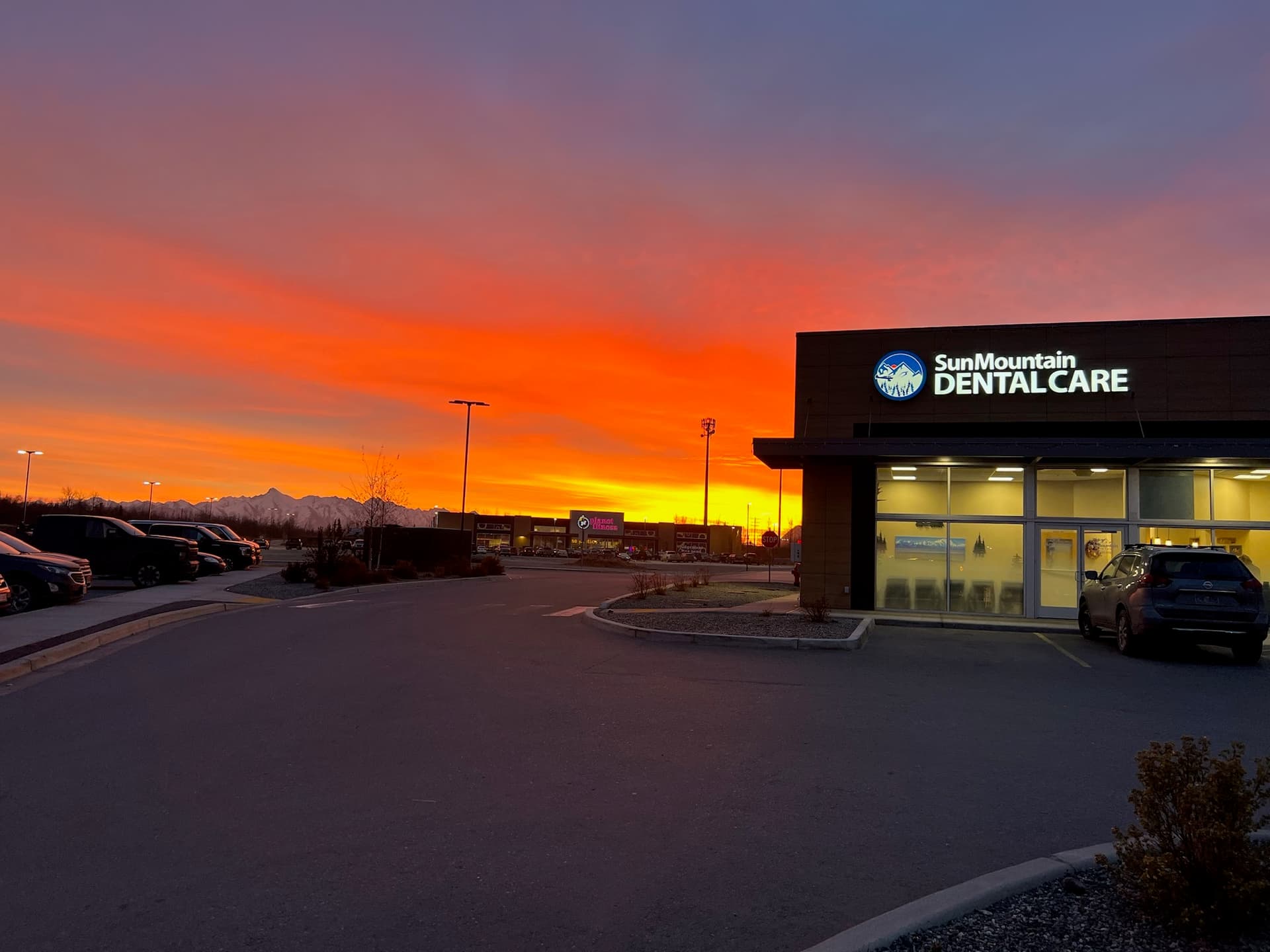
Conveniently located at 2101 E. Sun Mountain Ave, Suite 107, Wasilla, AK